Saturday, 17 April 2021

Working Costumes Images Project

This post will serve as a direction for Pinterest boards with source images for each decade. I'll be coming back here to edit and add links as I begin each board. I will also try to use this post as a Directory of other posts on this Project.

Links

}To be added over time {

Commentary

I'm calling this project the Working Costumes Images Project.

Working - the women I am interesting in researching about, were working women. Some worked in the home, others outside. Some were primarily care-givers and household managers. That is still work! They, however, were not women with vast amounts of leisure time, nor ones who wore multiple outfits per day. Their clothing was practical, often home-made or home-finished, and valued durability and comfort over fashion and image. That said, they weren't dead to fashion, and would have made efforts to at least have the appropriate silhouette, and to not look "dowdy". We can still date ordinary women's photo images by the clothing they're wearing, but perhaps not as precisely as for High Fashionistas, but usually within a year or two. That said, the older a woman got, the less likely she was to care about how up-to-date she was, as happens still today. Why get a new, more fashionable dress, if the old one still fits and looks fine? Waste not, Want not... Using "Working", but not "class", I feel can be used to encompass all these women.

All this said, I'm not focusing on those at the absolute bottom. I am hoping to focus on women who were able to buy shoes for their children, ensure adequate food, and have non-ragged clothing. They may have held down jobs, but they were mostly focused on the job of the home. Unlike the upper middle classes, however, they were often one step away from disaster, and would probably not have had much, if any, assistance at home. Their husbands (because marriage was a career at this time) would have worked 6-7 days a week, and often long hours. Holidays would have been rare outside of religious festivals, until the mid19thC rise of leisure time. Single women would have worked, and many would have remained at home or lived with a (married) sibling. The workhouse would have been a real threat to them, and a genuine fear. 

Key words:

  • Practical
  • Durable
  • Worker
  • Domestic
  • Appropriate-to-task (i.e. not a ball dress while washing up in the scullery)
  • Comfortable
  • Economical

Other points

Fabrics. Wool, linen, cotton more than silks and other high status fabrics. Cotton only once the prices became affordable. Wool remained desirable for its fire-retardant qualities as women were frequently around open flames.

Piecing. Piecing is period for almost all classes, but for those at the lower end of the social scale, economy was an essential virtue.

Colours. High fashion colours may still have been worn by working women if they had access to dyes to over-dye things at home, or if they could purchase a second-hand item in the desired colour.

Re-use. Buying new shoes or gloves when your old ones were still good were wasteful, and therefore less likely to happen. Buying new gloves for Sunday Best, and gradually rotating them into general use before buying new ones for Sundays, however, wasn't unlikely, especially for middle class women. For those at the bottom, gloves would probably have remained optional outside of the need and desire for warmth. The same for shoes and boots.

Re-fashioning. Making the same item over to line up with newer fashions was also common among all classes. Whether that was changing a belt, collar, or bonnet to match newer fashions, or setting entirely new sleeves into an older dress to match current fashions.

Practicality. A dress which had multiple potential uses was far more use to a non-elite woman, than a dress that could only be used in one context. Re-wearability was also essential. 

Durability. A dress, shoes, bonnet, or gloves that could last multiple years was a good thing. Making over your one winter dress to update it to a new fashion was far more desirable than buying a multiple cheaper but flimsy constructed items that didn't last. An item that could stand up to being adjusted, taken in / out, and having minor changes to update it, was a good item.   

Economy. While a dress might be made of cheaper types of fabric, or better value options, there was no reason why small parts couldn't be made of more expensive things. Ribbons and trimmings were common on clothing for all women, and a working woman might wear an expensive ribbon belt with her best dress, or have a carefully trimmed bonnet with silk flowers. While she might not have been able to afford a lot of luxuries, than as now, people sort out small things to make themselves smile. Life wasn't all drudgery, and small things could make big differences, in life and in fashion.

Saturday, 10 April 2021

New Brain Squirrel!

 So recently I've been thinking a lot more deeply about how I want to approach historical costuming for me. Both in the direction of historically adequate and inspired work for everyday, but also for more intentional costuming, e.g. for events.

So my first issue is physical. Me. I am not young, I am not princess-beautiful, I am not single, and I am not slim. I am (mostly) OK with myself - I don't mind my age, or my looks, and I'm not getting a divorce; yeah, I need to lose some weight, but even without the extra I will never be slim because my frame is naturally broad and solid. I am from working class and middle class stock, and it shows. And I am good with that. BUT I need to work with that, rather than pretend to be something I am not. 

To look at this from a historical perspective, in past centuries a woman of my background, marital status and appearance would have been heavily mocked for "aping her betters", or for pretending to be something she wasn't. High fashion is usually, then as now, directed at the young, the rich, and the fashionable. Most of the country just weren't that, and wee unlikely to have seriously desired it. Would living a life of luxury have been nice, of course, but you could daydream while washing the dishes, managing a home, and raising the children, because life as always carries on needing to be lived.

The upside of this, from my perspective, is that clothing that the average woman would have worn was more likely to be practical and usable in daily life. Ball gowns are pretty, but aren't really practical for wearing on a daily basis. 

All that said, even lower class women may have owned one or more nice dress. 

  • It may have been a wedding dress, much amended over time, and adjusted to accommodate new necklines or hemlines. 
  • It may have been bought from a clothes reseller - second hand markets have existed for a Very Long Time, and have always been a way in which men and women could potentially access to things otherwise out of their reach. 
  • It may also have been a gift. Gifts of old clothing from employers to servants, particularly in a domestic setting, were not uncommon. These clothes, while no longer high fashion enough for those who were being served, were absolutely acceptable for Sunday Best for those serving them, perhaps with a little adjustment. And if no longer usable as-is, the gifted clothing could happily be made over into something else more suitable to their needs (or indeed sold on via the above mentioned second-hand trade). The giving of clothing and/or fabric as gifts to vassals, to indicate favour, or indeed to curry it, has been used since at least the Elizabethan era, if not earlier[1]

So what does this mean for me, and what has my Squirrel Brain decided to do?

For me, it means I want to concentrate more on making clothing that my ancestors would have worn, rather than "Princess Pretty" clothing. That means middle to working class mostly, with a mixture of rural farming society, urban domestic servants and some northern factory mill workers. These were people who were more likely to be illiterate to functionally literate, than readers of magazines. If they did see fashion plates it would not have been because they sought them out, and more like when I look at the houses in Country Life - ultimately not something I ever expect to own anything even close to!

And as for my squirrel brain? Well that's decided on a new Project, which is superficially simple, but may prove to be Quite Long... Squirrel Brain would like me to find images of at least one working to middle class costume that I like, for each decade of the 19th Century, and possibly early 20th Century too. And then to make them up. Perhaps one working, and one middle class. This isn't to say I can't make the Pretties too - as above, women could still access nice clothes; plus I can make what I like for the fun of it! However, I probably will not count anything like this towards this project. 

The Plan

First step in this project will be gathering images. Initially photos to give the impression of a decade, and then picking specific looks to recreate. While I'm doing that, I will probably work on underwear for a while, as that will also be necessary for anything I make outside this little (hah!) project. After that, will be the long process of creating them...

To be helpful to myself, I'm not going to do this chronologically, but instead let my brain bounce around as it wills it. That has the advantage of while I want to get stuck into more complicated eras to source at the beginning of the 19th Century (i.e. before widespread photography, and when the average person wasn't getting their portrait painted), I can also do easy bits bringing in images I already have from the 1890s-1920s period. 

I may do years within a given decade for later periods where we have more surviving source material for me to use. Nevertheless, I want to stick to a minimum of one costume per decade, with more being a nice-to-have option.

I also am seeking to actively avoid uniforms and livery. The stereotypical working-class image of a 19th Century woman is of the domestic servant, but while I am interested in her clothes, what I want to recreate is what she wore when not a work. Basically, going beyond the stereotype of the black dress with the white apron over it. What did she wear on Sunday? What about after she married and left service (if she did)? Those are the outfits I'm seeking to find.

While I'm happy to look at extant examples of clothing, for this project I want to focus on images from the time. Images show you want was being worn, by whom (status/class), and how. I hope to only use museum examples to pad out the iconographic resources, rather than replace them, although I have no idea how successful that idea will be!

Is this all I'm going to be doing for the future? Oh no. Definitely not! I have other plans in the pipeline, and idling in the back of my head still, but this is something I want to do gradually over the next few years. In the long run, it may even be able to be a resource that others can use on middle to lower class fashions.

Citation

[1] One example would be the donation of a dress (or dresses) by Elizabeth I of England to the wife of a prominent Irish nobleman who she wished to have allied with her.

Tuesday, 6 April 2021

April craft plan

 April rough craft plan, plus What I Did In March. I admit to cheating slightly this month. I had my dose#1 of the vaccine, which completely knocked me flat for a while, so I allowed myself to skitter into the Easter weekend. However, life proved to be uninterested in letting me follow my original plans! I was ill, again (this is getting to be a very exasperating theme!), and I have had to face up to the fact that I am just not going to complete March's challenge. 

I have instead completed a major chunk of the rework of our spare room this month, so instead of feeling down about the March challenge, I am going to feel good about that! 

Other positive achievement this month is that my main Discord server has agreed to select it's own monthly challenges. I'll probably be following those more from April onwards instead of the ones set out at the beginning of the year.

April plans

Completed (spare room)

  • Cleared the floor
  • Moved the bedframe
  • Filled at least a dozen bin bags and 3-4 bags of paper goods for recycling as well.
  • Hoovered the floors and won the fight against cobwebs, and general ick
  • Steam cleaned the windows and sills
  • Removed damp marks from one part of the wall
  • Taken down the old dirty curtains and nets - to be washed tomorrow
I also completed (with spouse's essential assistance), a first draft of my "boob mould". This is intended to be a rough mould of my breast cup shape, to help with adjusting the cups on my Regency stays

Carried over

  1. HelloFresh cushions
    Make a cushion out of junk fabric and the ex freezer bags from HF
  2. May challenge
    Order fabric
    Start plotting out the patterns for 2 sarafans
  3. April challenge suggestions
    Breast Cut out skirt pattern for April
    Cut out mock-up shirtwaist for April
    "Breast block" for my 1830s/Regency stays 
  4. Reading
    Left-handed Booksellers of London / Garth Nix
No pic tax as they photos are on my phone, and I'm not. I plan to share more as a general before/after post once the whole room is done.

April Plans

Non-Challenge

Back Room
  • Wash curtains and nets
  • Measure window for new blind
  • Steam and then scrub other bit of wall that has damp marks from lack of airing
  • Steam clean front of radiator
  • Move remaining boxes
  • More hoovering!
  • Destruct old wardrobe that is not needed in that room - it's not in good enough condition to move out of the room, unfortunately.
  • Build IKEA furniture
  • Move PC and start organising craft stuff into the big Kallax

Reading 
  • Left-handed Booksellers of London
  • Blood of Elves (Witcher) - need to return to library soon
Crafting - Boob mould (a second attempt) with better separation. Last try had a mono which is no use for sizing cups!

Challenge inspiration: Apparel Appreciation OR Adapt and Alter

  1. Fan skirt
  2. Shirtwaist / blouse
  3. Regency bonnet
  4. Regency/1830s stays - wear under modern clothes

    Draft Plans for 2021 forwards

    1. Hats
      1. Regency
      2. 1890s/Edwardian
    2. Fan-skirt
      1. Wool blend
      2. 100% wool
    3. Stays
      1. Breast cups work - adaptation from D cup to my more copious HH/J cup size
      2. Mock-up
        Because needed for Regency dress mock-up
      3. Buy wooden busk
      4. Final version
    4. Edwardian blouse / shirtwaist
      1. Mock up
      2. Final
    5. 1818 Dress
      1. Petticoat
      2. Mock-up
      3. Final
      4. Decoration
    6. American Duchess cape, but with a hood
    7. 1890s men's three piece suit
    8. 1830s men's three piece suit
    9. 1950s dress(es)
    10. Circle skirt
    11. Princess Charlotte's Russian Dress
    12. Cycling shorts (modern, padded)
    13. Cycling trousers (historical, to accommodate modern underneath)

    Monday, 1 March 2021

    March craft plan

    What I Did in February

    Short answer - a lot less than planned! A general lack of spoons, followed by a nasty incident with a cowboy builder which completely stole my remaining ones. I made a last ditch effort to get back on track on Sunday 28th February, and here's where I am

    My original plan was to finish my fox toy that I began on holiday last August, but it's still not quite there yet... So, today I looked at the house and instead "finished" clearing up some boxes with clothes identified as "potentially salvageable".

    I now have a small pile of things that can be donated after a wash. A second pile of tops that need to be tried on as they probably still suit me. A bin liner with stuff that is just not worth saving (e.g. an old fake leather skirt that was literally disintegrating. And finally a pile of fabric and fittings (like zips) that can be repurposed. Plus one skirt that has special memories so I'm not getting rid of it!

    Some photos below to keep up with my plan to "photo tax" each month. Pretty pathetic for this month, but I need to get into a habit, so whatever I completed, is getting photographed regardless!


    March craft plan

    Proposals / suggestions

    Challenge inspiration: Mod it and Mend it March

    1. HelloFresh cushions
      Make a cushion out of junk fabric and the ex freezer bags from HF
    2. May challenge
      Order fabric
      Start plotting out the pattern pieces for sarafan set(s)
    3. April challenge preparation
      Cut out skirt pattern for April
      Cut out mock-up shirtwaist for April

    Draft Plans for 2021 forwards

    1. Sarafan costume / Snegurochka / Vasilissa
      1. Dress
      2. Belt & tassels
      3. Kokoshnik
    2. Hats
      1. Regency
      2. 1890s/Edwardian
    3. Fan-skirt
      1. Wool blend
      2. 100% wool
    4. Stays - Black Snail pattern
      1. Breast cups work - adaptation from an average D cup to my more copious cup size
      2. Mock-up
        Because needed for Regency dress mock-up
      3. Buy wooden busk
      4. Final version
    5. Stays/Corset - à la paresseuse
      1. Rescale pattern
    6. Edwardian blouse / shirtwaist
      1. Mock up
      2. Final
    7. 1818 Dress
      1. Petticoat
      2. Mock-up
      3. Final
      4. Decoration
    8. American Duchess cape, but with a hood
    9. 1890s men's three piece suit
    10. 1830s men's three piece suit
    11. 1950s dress(es)
    12. Circle skirt
    13. Princess Charlotte's Russian Dress
    14. Cycling shorts (modern, padded)
    15. Cycling trousers (historical, to accommodate modern underneath)
    16. Fox toy - finish and stuff.

    Future Events

    2021 is looking to be almost as devoid of events as 2020, for good reasons. That said, I currently have two events that I'm planning for, which should still happen this year, plus a few longer-ahead plans...

    July 2021

    Holiday
    Family wedding

    The holiday is definite unless we get ANOTHER lockdown over that week, and is timed to coincide by location and date with the wedding. If the wedding is unable to go ahead as planned (either by date or by permitted guests) then we'll still have the holiday.

    Autumn

    Jane Austen Festival in Bath - might be 2021, but not sure if it'll happen this year.
    Whitby Goth Weekend - for some lovely fake Victorian posing

    Discord 2022 ideas

    NB these are all just speculative ideas that have been mooted on Discord. Nothing here is even as far as the planning stage!! However, since they're ideas of what people might want to do, they're good things to aim at making something that would be suitable for that sort of event.

    Meet up in Lord of the Rings influenced gear, for fun, maybe Royal Armouries in Leeds
    Seaside themed day/weekend in somewhere like Brighton
    Medieval gear and jousting tournaments
    Photos at a country house

    Other 2022 ideas

    Victorian Fancy Dress Ball with La Rose Soirée

    Saturday, 20 February 2021

    Infertility, Fertility, and Subfertility

     This is a more personal post that I sometimes write, but which will serve for an introduction into a planned short series of posts on this subject.

    NB, while I will try to stick to neutral terms, many of my sources do not, so apologies if I appear to flip between gendered and neutral terminology. 

    Infertility affects men, women, and those who identify as both or neither. Infertility doesn't care if you are married, single; old, young; gay, straight; poly or monogamous; what race, colour, nationality or heritage a person has. It doesn't care about any of those, or anything else. It doesn't discriminate, and neither should we. 

    Definitions

    Fertility

    Fertility is defined as "the quality of being fertile, productiveness", and while it can refer to non gestational matters, such as the imagination, it is usually used to refer to the ability to conceive children or young of any species.

    Infertility

    Infertility is technically the absolute opposite of Fertility, as can be seen by the quotes below:

    "...infertility is defined as not being able to get pregnant (conceive) after one year (or longer) of unprotected sex." ~ CDC, USA
    "a disease of the reproductive system defined by the failure to achieve a clinical pregnancy after 12 months or more of regular unprotected sexual intercourse." ~ World Health Organization
    "Infertility is when a couple cannot get pregnant (conceive) despite having regular unprotected sex." ~ NHS, UK
    "Infertility is the inability of a person, animal or plant to reproduce by natural means." ~ Wikipedia

    According to the WHO, there are three types of Infertility:
    Disability - whereby infertility is caused by external factors, such as maternal sepsis or unsafe abortions. This is thought to predominantly affect developing countries.
    Primary - the inability to carry a pregnancy to a live birth, ever
    Secondary - when a person has had one (or more) live births, but is unable to conceive or to carry to live birth any subsequent pregnancies.

    Subfertility

    Subfertility is an underused term, in my opinion. Its definition is as follows: "Subfertility generally describes any form of reduced fertility with prolonged time of unwanted non-conception." ~ Gnoth et al.

    Subfertility as a definition can be seen to hold a position on the continuum in between the absolutes of Fertility and Infertility. If fertility is the presence of the ability to reproduce, and Infertility the absence of that ability, Subfertility is the state whereby a person who can't reproduce may be helped.

    It is notable, to me, that our local NHS clinic, is known as a subfertility clinic, rather than an infertility clinic. I like this, because for me it implies that their place is to assist people in moving towards Fertility, not in moving them Out of Infertility. 

    I find that I dislike "Infertile" as a diagnosis as it feels fixed, insurmountable, and immutable. If you are infertile, then you have reached an absolute, a state which is unchangeable. Subfertile feels like a medical professional is acknowledging that you need assistance to achieve "Fertility", but that there is the potential to get there. You might need medication, assistive reproductive techniques (IUI, IVF), donor gametes, or a gestational carrier, but you have the potential to achieve "fertility"...

    A Series?

    So, I mentioned I plan to make this a set of posts. I don't plan to write and/or post them in any particular order, or without any other subjects else covered in between, but here is a rough list of my intentions:

    1. How to get pregnant and when to be concerned
      Like many people, my Sex Ed at school focused on NOT being pregnant, and in many ways overemphasised the risks of sexual activities as MIGHT became WILL. This is intended to give a brief balance to that and then to state when you should go talk to a doctor.
    2. Miscarriage - facts and support. 1 in 4 pregnancies don't make it to live birth, but we still don't talk about it. Miscarrying is horrid, but not something to be ashamed of.
    3. Assisted Reproductive Techniques 1 - IUI
    4. Assisted Reproductive Techniques 2 - IVF and related ICSI, IMSI, and IVM
    5. Donor gametes, DNA, and genetics
    6. Gestational Carriers & Surrogacy - you are still the parent
    7. "Bingo!" - why saying "Think Positive" or "Just Adopt" will likely make the hearer want to poke you in the eye
    8. Other ways to make a family
    Needless to say, a lot of this will be UK focused, as that's where the plurality of my information comes from, but I plan to include wider international information where possible.

    The intention behind this loose series is to provide a place to share thoughts and information with friends and relatives dealing with various aspects of this whole shitshow.

    Monday, 15 February 2021

    Monthly craft plan - Overview 2021

      I've decided I'm going to post a simple projects plan at the beginning of each month. Three contingencies though for my mental health:

    1. No guilt - If time slips, it slips, I will not feel guilt for life, health, or finances altering my plans
    2. Plans may change - I can make any changes needed to allow for life, health, and "other stuff"
    3. Nothing is final - To allow for the above, I acknowledge that plans are just that, plans, not final decisions.

    Overall craft plan

    General list
    1. Hats
      1. Regency
      2. 1890s/Edwardian
    2. Fan-skirt
      1. Wool blend
      2. 100% wool
    3. Stays
      1. Breast cups work - adaptation from D cup to my more copious HH/J cup size
      2. Mock-up
        Because needed for Regency dress mock-up
      3. Buy wooden busk
      4. Final version
    4. Edwardian blouse / shirtwaist
      1. Mock up
      2. Final
    5. 1818 Dress
      1. Petticoat
      2. Mock-up
      3. Final
      4. Decoration
    6. American Duchess cape, but with a hood
    7. 1890s men's three piece suit
    8. 1830s men's three piece suit
    9. 1950s dress(es)
    10. Circle skirt
    11. Princess Charlotte's Russian Dress
    12. Cycling shorts (modern, padded)
    13. Cycling trousers (historical, to accommodate modern underneath)

    Saturday, 13 February 2021

    2021 Craft Plans

     While I've completely missed January, and we are now well into February, I thought I'd share my rough plans for the first part of 2021 at least.

    First note is to say that while my 1818 ensemble is still in the works, Plague and lockdowns are putting September 2021 strongly into doubt as a physical meeting for me. I'm now mentally putting it as September 2022 for Plague and Other reasons. It's both sad and good - sad because it would have been fun, and good because I have longer to plan it...

    So, first things first is to say that I am broadly planning to follow the Historybounding Discord's challenge for the next few months.

    1. Finish It February
    2. Mod It and Mend It March
    3. Apparel Appreciation April
    4. Myth May
    5. Pride Month June
    6. Just Use Stash July
    7. Alterations August

    February 

    I will either get my Regency bonnet completed, or finish off a fox toy I started sewing last summer. Probably the latter due to the lack of days in February!

    March

    I have a LOT of things that need mending kicking around, so I'll find something for that! And then make a start on April. 

    An alternative is to act on a Very old plan to convert some of the many Hello Fresh "freezer bags" we got some years back into one or more cushions.

    April 

    I'm not sure here. The guidance is to just mix and match eras, so maybe I may make up my Victorian walking skirt, but pair it with some existing 50s style tops I have.

    May 

    For this, I plan to put into action the research I did for the Foundations Revealed competition, that then had to be shelved due to health reasons. I plan to make a sarafan (and possibly the rest of the outfit) for Vasilissa the Wise and/or Snegurochka.

    This is one month where I will need to start work well in advance of May, due to the need to purchase supplies.

    June 

    I, currently at least, have no idea how to "make it gay". Maybe I'll make something in the Ace colours? I am neither a rainbow nor a pink person, so the traditional Gay or Bi pride flags won't work for me...

    Asexual Pride Flag - Black - Grey - White - Purple
    Source: Wikipedia.

    July 

    I have stash, I can use those! Maybe using some of the buckram stash to make another hat?

    August

    Alterations could be a great thing, especially if we're able to travel by then and I can gather some of my old clothes from my parents...

    Thursday, 8 October 2020

    The Outer Layer - Head

    Oops, procrastination and squirrel brain posts have unintentionally pushed this one back from when I originally scheduled it to post... By 2 weeks at least now. Sorry! I had intended to do the Regency Wardrobe group as a straight series of posts, but brain go "Wheee! Look over there!" and I did. Mea culpa...

    So back to the original plan: The outer layers of my planned Regency costume.

     The outer layer in this project is the layer where I will attempt to make something, but where I accept that I may well run out of time. For the purposes of these posts I am going to list the things I would like to make (and may make later if I don't have time this time), and alternatives I may consider adding instead. I am considering here three specific areas:

    1. Head
    2. Body
    3. Feet

    Head

    Head coverings of some kind were both normal and socially acceptable for adults of both genders. For women what was expected would vary depending on their age, but even in a ball situation, the hair would have some sort of decorative covering, even if it did more to adorn than conceal. Depending on your age, wealth, and taste, these could range from simple and plain, to incredibly elaborate affairs. Common types of coverings included Caps, Bonnets, and Turbans.While millinery was a definite profession by this time, it wasn't uncommon for women to buy hats to trim at home, or to trim and retrim the same hat to go with multiple outfits, so fashion plates were useful places for the contemporary woman to gather inspiration. It has been argued that these plates show the extremes of fashion, akin to modern catwalks, or show composites of various options which could be mixed, matched, and omitted according to the wearer's tastes. Being able to modify or create your own headwear allowed women, in particular, a lot of capacity for personalisation.

    So what would a women in around 1818 have worn throughout the day?

    In the morning, women wore lighter headwear, such as lace caps, linen bonnets, and similar items. These were "at home" items, and seem to have been commonly made of the same sort of fabrics and colours as both visible and intimate underwear. The fashion plate below shows a woman sitting in a very decorated yet simple white dress. The tucks and lace on the hem are reminiscent of petticoat edgings. The dress has looser sleeves than the dresses worn outside or later in the day, and the fichu at the neckline would have kept her warm in a colder house. Her cap is completely in line with this "undress" fashion style, with a deceptively simple fabric cap to keep her hair out the way. I say deceptively, because like her dress, the simple shape is then covered with a huge ribbon (the width and depth of her forehead), and a very frilly decorative border. The whole ensemble is about the impression of intimacy, for an at home, without actually being either simple or undressed.

    Morning Dress, 1818, La Belle Assemblée


    Candice Hern's Regency World shows a number of fashion plates of hats dating from this about 1800-1817. Although there were variations each season and by activity, from about 1815 one popular shape for daywear was of a blocky crown (think of the crown part of a top hat) tilted back about 45° from the face, with a curved brim. The brims on this style gradually grow deeper and more exaggerated as the years progress. By 1818 a fashion plate from La Belle Assemblée shows a deep sweeping curved brim coming out from the nape of the neck outwards to shade the whole face, and then upwards above the face. The upper tip of the brim is about the same distance up from the head as the crown, or even a little further, and forms an angle of about 90° with the crown. Depending on the style, some brims form a straight line out from the crown, and others have a slight curve. All the plates I've seen of this style of bonnet, show that the edge of the brim, and the top of the crown were Very heavily decorated, with options such as lace, ribbon ruffles, and what looks like cording being quite popular. They were then finished with a broad ribbon running from the centre of the crown down to a point below the chin. This was to secure the bonnet to the head. It's not clear from the plates whether this ribbon was sewn into the seams of the bonnet form itself, sewn into the covering, or attached underneath a band around the base of the crown. Some prints (e.g. the middle left one in the image below) have a triangular effect with the chin ribbon being mirrored upwards and then along the back edge. The others on the page show a slightly puckered ribbon extending out below the crown ribbon.

    Parisian Bonnets, 1818, La Belle Assemblée

    Evening Dress fashion plats often seem to show a type of hat that is reminiscent of military hats, covered with a riot of feathers. Unlike the bonnets described above, these are worn much more vertically up from the head, extending the profile upwards, with the feathers above even the tops of the hats. Other evening dress plates show more turban like affairs wrapping around the hair, and again topped with feathers.

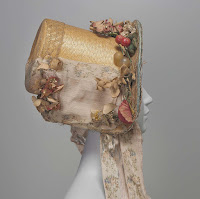
    An undressed bonnet was not a thing that a lady of the time would have accepted! In addition to the edge trims, bonnets were also decorated with floral decorations, and possibly other natural items. This poke bonnet from the 1820s at the Met Museum, while of a different bonnet shape from the 18-teens, shows a wonderful riot of leaves, flowers and other plant matter. Decorations were seasonal and also influenced by activity. Feathers seem to have been prefered for evenings, and also for winter outdoors activities like riding. Flowers were popular for daytime wear in the spring and summer. Autumn seems to have brought in berries, leaves and other foliage. Ribbons

    Hats and bonnet forms were often covered in silks, which could be of a coordinating or in a contrasting colour. Other fabrics could be used depending on your means and your outfit, but silk appears to have been both the most common (or the most common to survive) and the ideal described in the women's journals. 

    Making

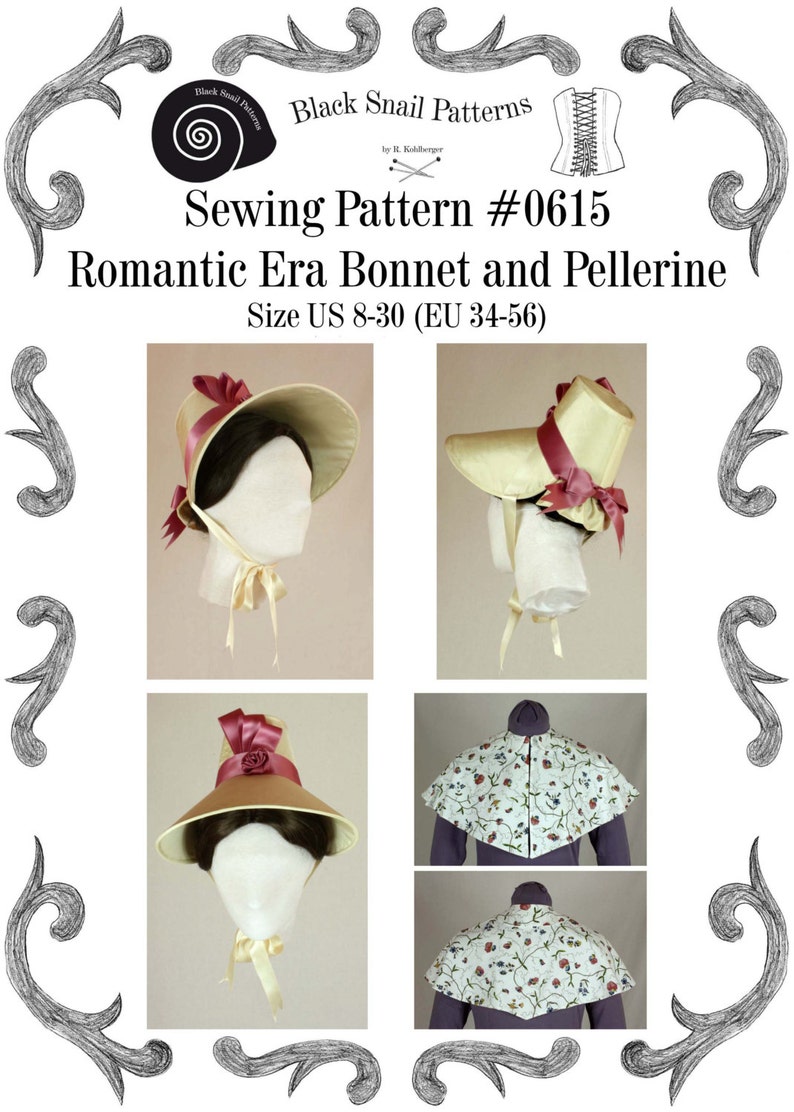
    So what have I gone for? I decided quite quickly that a bonnet in the style of the Parisian Bonnets plate above would be the most appropriate option for me, based on the time of day (afternoon), the activity (a promenade), and my personal preferences. While looking at Black Snail Patterns during their sale, their "Romantic Era" bonnet pattern fell into my basket. *cough* Although this pattern is designed for about a decade later, the broad shape of the bonnet in the pattern is not dissimilar to the one above, and I felt that it wouldn't be too difficult to adapt to the 1818 shape. If it doesn't work, I may just go ahead and draft my own pattern instead!

    Black Snail Sewing Pattern #0615 - Romantic Era Bonnet & Pellerine

    I am currently piecing together the PDF pattern for this bonnet, as I plan to decorate it for part of my Harvest Hat challenge entry.

    I will post the Body & Feet work in a separate post, probably tomorrow, as this one has got rather long. Again.

    Thursday, 1 October 2020

    October craft plan

     I've decided I'm going to post a simple projects plan at the beginning of each month. Three contingencies though for my mental health:

    1. No guilt - If time slips, it slips, I will not feel guilt for life, health, or finances altering my plans
    2. Plans may change - I can make any changes needed to allow for life, health, and "other stuff"
    3. Nothing is final - To allow for the above, I acknowledge that plans are just that, plans, not final decisions.

    October craft plan

    October
    1. Harvest hat
      a) Regency
      b) 1890s/Edwardian
    2. Fan-skirt (wool blend)
    3. Mock-up stays
      Because needed for November dress mock-up
    4. Mock-up Edwardian blouse
      If time
    November
    1. Continue work on Regency stays
    2. Mock-up Regency dress
    3. Final Edwardian blouse
    December 
    1. Final stays
      a) Lots of adjusting probably needed, and
      b) December is likely to be busy!
    2. Christmas presents!
    January
    1. Final Regency dress
    Unspecified
    1. Petticoat
    2. Chemise
    3. American Duchess cape, but with a hood
    4. 1890s men's three piece suit
    5. 1830s men's three piece suit
    6. 100% wool skirt

    Saturday, 26 September 2020

    Harvest Millinery - inspiration post

    This is going to be a fairly light post with links and images to inspiration sources I have for each of my final ideas. This is not a decision post, because I haven't decided yet!

    1. Pseudo-medieval hood(ie)


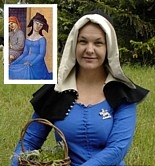
    This image from Rosalie Gilbert has a shape I love. I prefer closed to open hoods, but the buttons would allow me to make a hood in the open style but which can be closed when I want or need more insulation from the elements. She also includes a useful way to draft an appropriate pattern for this style.


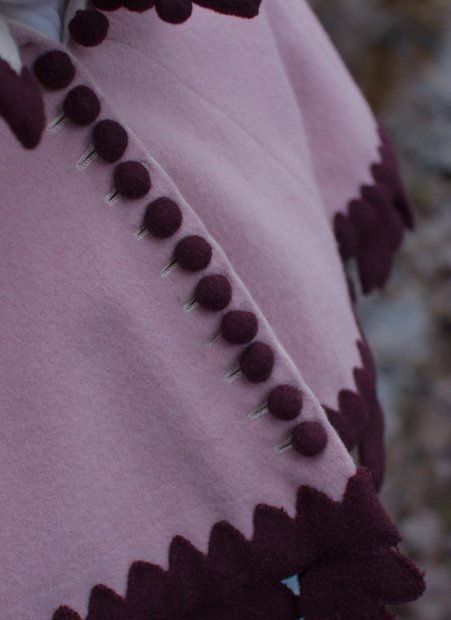
    Couture Mayah's post from 2011 shows a rather beautiful hood where she trims the hood using a contrasting wool for the dagging at the edges. 


    Racaire's Workshop has images of a lovely embroidered hood made in c2009. While the quality of the embroidery I feel is far beyond my current abilities, I am inspired by the use of contrasting the thread and fabric colours. Racaire suggests using chain stitch, which I know and could possibly work with providing the imagery was Very simple.

    Notably both the previous two examples refer to the Medieval Tailor's Assistant book, which I already own.


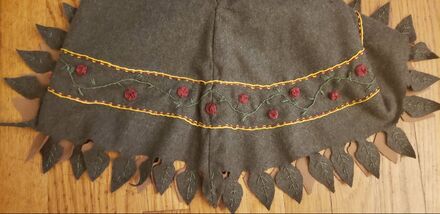
    Finally, I was really inspired by the decorations on the second (green) hood shown by Maille is Riveting. The idea of a simple band of decoration, plus the leaf-shaped dagging really got me excited to have a go. 

    I think that even if I don't do this for the Challenge, I want to do one anyway before the end of the year! In that situation, I will probably make the shape somewhat different from a normal late medieval hood, and take inspiration from ponchos (a longer back), consider making the front more of a scarf cross-over effect, and dropping the liripipe altogether.

    2. Simple Regency bonnet

    This is the bonnet pattern that happened to fall into my basket during the recent Black Snail sale:

    Black Snail: Romantic Era Bonnet pattern

    I could potentially trim the shape with autumnal themed items, like berries and leaves. I'm not sure, however, how autumnal colours will go with the petrol-blue of the dress I want to make.

    This hat from the Museum of Fine Arts, Boston, is a nice inspiration for trimming an 1820s hat. Although with the MFA hat being of a different shape to my pattern, I can't be certain how accurate it would be to transfer that style of decoration across to another type of bonnet.


    Another 1820s hat, but from the Met Museum, which has a brim somewhat closer to that of the pattern above. This one is even decorated in a style that could be described as almost Autumnal!

    For a style closer to the pattern, these images from a fashion plate of 1818 (La Belle Assemblée) show floral, foliage and ribbon decorations. Source: Flickr.

    3. Trimmed late Victorian hat

    Flipping through the Met Museum's web archive, I can see that straw based hats with wider brims were in fashion (with variations of course) from the 1890s through to the 1910s. That covers the 1890s of the fan skirt alongside the "Edwardian" of the blouse. While this costume would not be historically accurate together, I feel that none of it would be too out of place aesthetically when worn together.

    Possible sources of inspiration (All (c) The Metropolitan Museum of Art)


    This hat is dated 1892-95 and is made of straw with silk and feathers. The floral top decorations could make a nice historically inspired hat, but this hat itself would be useless in a practical sense because it is angled so as to leave the entire back of the head and neck exposed. No good if I wanted to wear this to keep the sun off.

    The Met also have a lovely simple boater from c1890, but I would be unsure whether that would be a woman's hat. That said, in a non-accurate costume, does that matter?

    Moving forwards to the 1910s, I found some much more useful images for inspiration. By this decade the hats seem to be angled towards the back of the head again, making them more useful for my modern wear. They are exceedingly extravagantly decorated in some cases, but that might be good for the Challenge, and at the same time, I can deviate if I choose since I'm not intending on creating a true replica.

    This 1910s straw hat has a band of what might be velvet underneath the brim, and a large cluster of flowers across the front brim. This style could be an awesome source for a Challenge hat - Straw base, autumnal coloured velvet band, and then a riot of autumnal leaves and flowers with a large ribbon around the crown.

    Another straw hat dated c1911 shows how the brim width and crown depth could vary. That's quite useful when finding a relatively inexpensive base straw hat to begin with.

    Instead of straw, this c1910 hat is described as being made of cotton, although in a similar shape and weave to the straw ones above. Like the first 1910s straw hat, this one has a band of fabric below the brim, and a wide band around the crown (of the same colour in this instance).

    A last straw hat, dated again to c1910, is also made of straw. It's quite a bright yellow, compared to the first two so may possibly be dyed, or even painted? In common with the first and third of 1910s hats linked above this hat has a band below the brim, and another around the crown. As for the first straw hat, the hat is decorated with flowers and leaves although here they are attached onto the front of the crown itself. This hat is also different in that it isn't the simple circular or oval shape, but instead has a downward sweep almost presaging the 1920s cloche hat. It's a rather lovely hat to take as a modern sunhat due to the deep drop of the brim towards the back, which would nicely protect the nape of the neck.

    Unfortunately, due to rights restrictions, none of images of the 20th Century hats can be reproduced, so you'll need to look at them on the Met's website.