Showing posts with label 19thC. Show all posts

Saturday, 10 April 2021

New Brain Squirrel!

 So recently I've been thinking a lot more deeply about how I want to approach historical costuming for me. Both in the direction of historically adequate and inspired work for everyday, but also for more intentional costuming, e.g. for events.

So my first issue is physical. Me. I am not young, I am not princess-beautiful, I am not single, and I am not slim. I am (mostly) OK with myself - I don't mind my age, or my looks, and I'm not getting a divorce; yeah, I need to lose some weight, but even without the extra I will never be slim because my frame is naturally broad and solid. I am from working class and middle class stock, and it shows. And I am good with that. BUT I need to work with that, rather than pretend to be something I am not. 

To look at this from a historical perspective, in past centuries a woman of my background, marital status and appearance would have been heavily mocked for "aping her betters", or for pretending to be something she wasn't. High fashion is usually, then as now, directed at the young, the rich, and the fashionable. Most of the country just weren't that, and wee unlikely to have seriously desired it. Would living a life of luxury have been nice, of course, but you could daydream while washing the dishes, managing a home, and raising the children, because life as always carries on needing to be lived.

The upside of this, from my perspective, is that clothing that the average woman would have worn was more likely to be practical and usable in daily life. Ball gowns are pretty, but aren't really practical for wearing on a daily basis. 

All that said, even lower class women may have owned one or more nice dress. 

  • It may have been a wedding dress, much amended over time, and adjusted to accommodate new necklines or hemlines. 
  • It may have been bought from a clothes reseller - second hand markets have existed for a Very Long Time, and have always been a way in which men and women could potentially access to things otherwise out of their reach. 
  • It may also have been a gift. Gifts of old clothing from employers to servants, particularly in a domestic setting, were not uncommon. These clothes, while no longer high fashion enough for those who were being served, were absolutely acceptable for Sunday Best for those serving them, perhaps with a little adjustment. And if no longer usable as-is, the gifted clothing could happily be made over into something else more suitable to their needs (or indeed sold on via the above mentioned second-hand trade). The giving of clothing and/or fabric as gifts to vassals, to indicate favour, or indeed to curry it, has been used since at least the Elizabethan era, if not earlier[1]

So what does this mean for me, and what has my Squirrel Brain decided to do?

For me, it means I want to concentrate more on making clothing that my ancestors would have worn, rather than "Princess Pretty" clothing. That means middle to working class mostly, with a mixture of rural farming society, urban domestic servants and some northern factory mill workers. These were people who were more likely to be illiterate to functionally literate, than readers of magazines. If they did see fashion plates it would not have been because they sought them out, and more like when I look at the houses in Country Life - ultimately not something I ever expect to own anything even close to!

And as for my squirrel brain? Well that's decided on a new Project, which is superficially simple, but may prove to be Quite Long... Squirrel Brain would like me to find images of at least one working to middle class costume that I like, for each decade of the 19th Century, and possibly early 20th Century too. And then to make them up. Perhaps one working, and one middle class. This isn't to say I can't make the Pretties too - as above, women could still access nice clothes; plus I can make what I like for the fun of it! However, I probably will not count anything like this towards this project. 

The Plan

First step in this project will be gathering images. Initially photos to give the impression of a decade, and then picking specific looks to recreate. While I'm doing that, I will probably work on underwear for a while, as that will also be necessary for anything I make outside this little (hah!) project. After that, will be the long process of creating them...

To be helpful to myself, I'm not going to do this chronologically, but instead let my brain bounce around as it wills it. That has the advantage of while I want to get stuck into more complicated eras to source at the beginning of the 19th Century (i.e. before widespread photography, and when the average person wasn't getting their portrait painted), I can also do easy bits bringing in images I already have from the 1890s-1920s period. 

I may do years within a given decade for later periods where we have more surviving source material for me to use. Nevertheless, I want to stick to a minimum of one costume per decade, with more being a nice-to-have option.

I also am seeking to actively avoid uniforms and livery. The stereotypical working-class image of a 19th Century woman is of the domestic servant, but while I am interested in her clothes, what I want to recreate is what she wore when not a work. Basically, going beyond the stereotype of the black dress with the white apron over it. What did she wear on Sunday? What about after she married and left service (if she did)? Those are the outfits I'm seeking to find.

While I'm happy to look at extant examples of clothing, for this project I want to focus on images from the time. Images show you want was being worn, by whom (status/class), and how. I hope to only use museum examples to pad out the iconographic resources, rather than replace them, although I have no idea how successful that idea will be!

Is this all I'm going to be doing for the future? Oh no. Definitely not! I have other plans in the pipeline, and idling in the back of my head still, but this is something I want to do gradually over the next few years. In the long run, it may even be able to be a resource that others can use on middle to lower class fashions.

Citation

[1] One example would be the donation of a dress (or dresses) by Elizabeth I of England to the wife of a prominent Irish nobleman who she wished to have allied with her.

Thursday, 8 October 2020

The Outer Layer - Head

Oops, procrastination and squirrel brain posts have unintentionally pushed this one back from when I originally scheduled it to post... By 2 weeks at least now. Sorry! I had intended to do the Regency Wardrobe group as a straight series of posts, but brain go "Wheee! Look over there!" and I did. Mea culpa...

So back to the original plan: The outer layers of my planned Regency costume.

 The outer layer in this project is the layer where I will attempt to make something, but where I accept that I may well run out of time. For the purposes of these posts I am going to list the things I would like to make (and may make later if I don't have time this time), and alternatives I may consider adding instead. I am considering here three specific areas:

  1. Head
  2. Body
  3. Feet

Head

Head coverings of some kind were both normal and socially acceptable for adults of both genders. For women what was expected would vary depending on their age, but even in a ball situation, the hair would have some sort of decorative covering, even if it did more to adorn than conceal. Depending on your age, wealth, and taste, these could range from simple and plain, to incredibly elaborate affairs. Common types of coverings included Caps, Bonnets, and Turbans.While millinery was a definite profession by this time, it wasn't uncommon for women to buy hats to trim at home, or to trim and retrim the same hat to go with multiple outfits, so fashion plates were useful places for the contemporary woman to gather inspiration. It has been argued that these plates show the extremes of fashion, akin to modern catwalks, or show composites of various options which could be mixed, matched, and omitted according to the wearer's tastes. Being able to modify or create your own headwear allowed women, in particular, a lot of capacity for personalisation.

So what would a women in around 1818 have worn throughout the day?

In the morning, women wore lighter headwear, such as lace caps, linen bonnets, and similar items. These were "at home" items, and seem to have been commonly made of the same sort of fabrics and colours as both visible and intimate underwear. The fashion plate below shows a woman sitting in a very decorated yet simple white dress. The tucks and lace on the hem are reminiscent of petticoat edgings. The dress has looser sleeves than the dresses worn outside or later in the day, and the fichu at the neckline would have kept her warm in a colder house. Her cap is completely in line with this "undress" fashion style, with a deceptively simple fabric cap to keep her hair out the way. I say deceptively, because like her dress, the simple shape is then covered with a huge ribbon (the width and depth of her forehead), and a very frilly decorative border. The whole ensemble is about the impression of intimacy, for an at home, without actually being either simple or undressed.

Morning Dress, 1818, La Belle Assemblée


Candice Hern's Regency World shows a number of fashion plates of hats dating from this about 1800-1817. Although there were variations each season and by activity, from about 1815 one popular shape for daywear was of a blocky crown (think of the crown part of a top hat) tilted back about 45° from the face, with a curved brim. The brims on this style gradually grow deeper and more exaggerated as the years progress. By 1818 a fashion plate from La Belle Assemblée shows a deep sweeping curved brim coming out from the nape of the neck outwards to shade the whole face, and then upwards above the face. The upper tip of the brim is about the same distance up from the head as the crown, or even a little further, and forms an angle of about 90° with the crown. Depending on the style, some brims form a straight line out from the crown, and others have a slight curve. All the plates I've seen of this style of bonnet, show that the edge of the brim, and the top of the crown were Very heavily decorated, with options such as lace, ribbon ruffles, and what looks like cording being quite popular. They were then finished with a broad ribbon running from the centre of the crown down to a point below the chin. This was to secure the bonnet to the head. It's not clear from the plates whether this ribbon was sewn into the seams of the bonnet form itself, sewn into the covering, or attached underneath a band around the base of the crown. Some prints (e.g. the middle left one in the image below) have a triangular effect with the chin ribbon being mirrored upwards and then along the back edge. The others on the page show a slightly puckered ribbon extending out below the crown ribbon.

Parisian Bonnets, 1818, La Belle Assemblée

Evening Dress fashion plats often seem to show a type of hat that is reminiscent of military hats, covered with a riot of feathers. Unlike the bonnets described above, these are worn much more vertically up from the head, extending the profile upwards, with the feathers above even the tops of the hats. Other evening dress plates show more turban like affairs wrapping around the hair, and again topped with feathers.

An undressed bonnet was not a thing that a lady of the time would have accepted! In addition to the edge trims, bonnets were also decorated with floral decorations, and possibly other natural items. This poke bonnet from the 1820s at the Met Museum, while of a different bonnet shape from the 18-teens, shows a wonderful riot of leaves, flowers and other plant matter. Decorations were seasonal and also influenced by activity. Feathers seem to have been prefered for evenings, and also for winter outdoors activities like riding. Flowers were popular for daytime wear in the spring and summer. Autumn seems to have brought in berries, leaves and other foliage. Ribbons

Hats and bonnet forms were often covered in silks, which could be of a coordinating or in a contrasting colour. Other fabrics could be used depending on your means and your outfit, but silk appears to have been both the most common (or the most common to survive) and the ideal described in the women's journals. 

Making

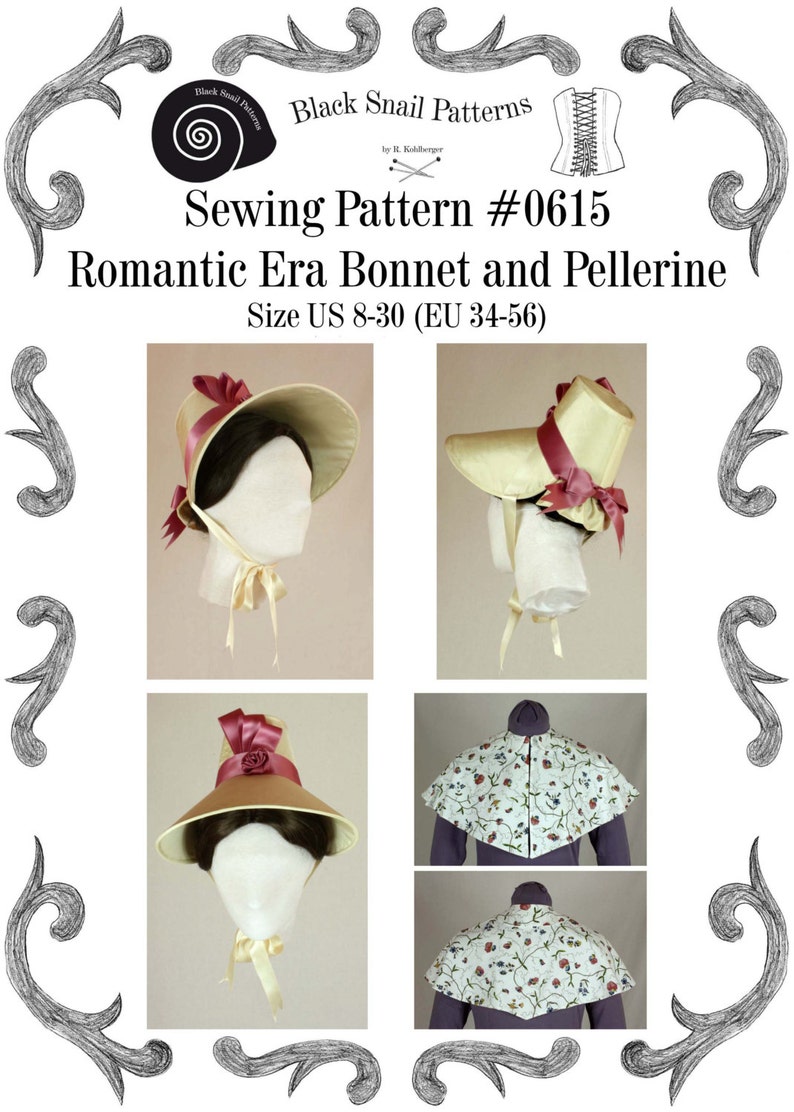
So what have I gone for? I decided quite quickly that a bonnet in the style of the Parisian Bonnets plate above would be the most appropriate option for me, based on the time of day (afternoon), the activity (a promenade), and my personal preferences. While looking at Black Snail Patterns during their sale, their "Romantic Era" bonnet pattern fell into my basket. *cough* Although this pattern is designed for about a decade later, the broad shape of the bonnet in the pattern is not dissimilar to the one above, and I felt that it wouldn't be too difficult to adapt to the 1818 shape. If it doesn't work, I may just go ahead and draft my own pattern instead!

Black Snail Sewing Pattern #0615 - Romantic Era Bonnet & Pellerine

I am currently piecing together the PDF pattern for this bonnet, as I plan to decorate it for part of my Harvest Hat challenge entry.

I will post the Body & Feet work in a separate post, probably tomorrow, as this one has got rather long. Again.

Wednesday, 16 September 2020

The Visible Layers: The Dress, Part 2 - Practical plans

Images of the two Regency dresses I would like to approximately recreate. L: Ginsberg 1818, M & R: DAR Museum, c1818-1820.
Cora Ginsburg & DAR Dresses

Analysis of the Dresses 

Bodice:

Both the Cora Ginsburg and the DAR Museum dresses appear to be back fastening (there is no obvious opening on either fronts). The DAR Museum dress has a centre front seam, which may be an opening, but that would seem unusual for the time period, leading me to believe it's either intentional construction (e.g. for maternity/postpartum) or an adjustment. The round neckline appears to be hemmed all the way up indicating a probable back fastening, as the bodice construction suggests that a front opening would not open wide enough to be put on with a fixed band at the high waist. The neckline is gently scooped and not completely square.

The decorations on the Ginsburg bodice would seem to preclude a front fastening, and the shoulders don't appear to have a bib front either. Unfortunately I've not got access to an unobscured back view of either dress to be sure exactly how either was fastened. I adore the "woven" appearance of the front decoration on the Ginsburg bodice, but I suspect that the DAR Museum dress bodice will be more sensible to make as a first attempt Regency dress. The woven effect, to me, seems to simulate the crossed over bodices that were also around at this time. This bodice's neckline is squared off, with straight lines across the breasts and over the shoulders, and with clearly defined corners to the line. 

Sleeves:

Both dresses have long sleeves, but with differences in the decoration at the shoulders and cuffs. The DAR dress has capped shoulders with the banded decoration to reflect the hems and cuffs, and then a long and fairly loose sleeve ending in a slight gathering before the cuff decorations. The Ginsburg dress has the more common puffed shoulder ending in a bad around the upper bicep, and then extends out into the long sleeve. The sleeves on this dress are not as straight at the DAR ones, but do appear to have more fabric in them. They are gathered into the top band, then remain reasonably loose until mod forearm at which point they are gathered in tight with a decorative band that is a couple of inches wide. The cuffs then puff back out and continue to approximately the middle joint of the thumb.

Due to the more conservative style preferred in the newly independent United States, the necklines are relatively high compared to European fashions for the same style of dress. Both dresses have a more defined bodice space than would have been seen a few years earlier, presaging the silhouette of the 1830s.

Skirts and hemline

Both dresses are placed on mannequins to show a hemline that is just short of trailing on the floor, and neither has any evidence of a train. Both dresses are straight down from the high waists, projecting gently outwards to a width a few inches wider than the natural shoulders. 

The decoration on the DAR dress continues about a foot up the dress from the hem, whereas that on the Ginsburg dress only covers about half that height. The Ginsburg decoration is more fancy, but the contrasting colouration 

Possible patterns

There are a number of excellent patterns out there for Regency dresses, as well as guides and diagrams for DIY or draped variants. I'm certainly not experienced enough to drape, and I prefer the comfort of having a pattern, even if I often only follow them broadly. A non exhaustive list of pattern companies (in no particular order) includes: Black Snail, Laughing Moon, Sense & Sensibility, Folkwear, and Nehelenia. I've not linked to any of these as the best value vendors for any may vary depending on where you are based and which currency you are using, however many use Etsy or have resellers on there, so that may be a good starting place to look.

My shortlist is based on patterns which appear to be close to the design of the two dresses I have been talking about in detail in this post and the previous one. I knew that finding an exact pattern for either dress was likely to be impossible, so I took what I decided were the key features of both, and focused on those when searching for the most appropriate pattern for me. The key features I decided on were:
  • Back fastening
  • A simple neckline, either squared off, or more rounded
  • Not too high a waistline, and one that was in the cut of the pattern (not defined by a belt only)
  • The plain flat front of the DAR Museum dress
  • A (high) waist seam as part of the dress
  • The puff-band shoulder on the Ginsburg dress
  • Long sleeves that are not tight.
By looking for a back fastening dress, I had to rule out a number of earlier Regency patterns (logically), as the earlier period was better known for the bib fronts to dresses. Some earlier patterns were also ruled out because the bodice shaping was less defined by the cut and more by the belt/overdress. Relatively few patterns had long sleeves, instead going for the short sleeves more suited to hotter climates than an autumnal England! I also wanted that shoulder interest that is in both of my inspiration dresses, so no patterns where the sleeve falls straight from the armscye.

That left me with two patterns! Laughing Moon #138 & Sense & Sensibility "Regency Gown". Technically there is a third, from Fig Leaf, but I found that one after I had completed my purchases.

Laughing Moon #138

Envelope for Laughing Moon 138 - four dress views with long and short sleeve variationsBack of pattern envelope


None of the views on this pattern have the very square neckline shown on the Ginsburg dress but are quite similar to the DAR Museum dress' neckline. The shape of the skirts on all views look appropriate to either of my inspiration dresses.The short-sleeve over long sleeved variant is very reminiscent of the Ginsburg shoulders and sleeves, although a bit too baggy. The way they are made, however indicates that adapting the pattern to have a smoother sleeve could work well.

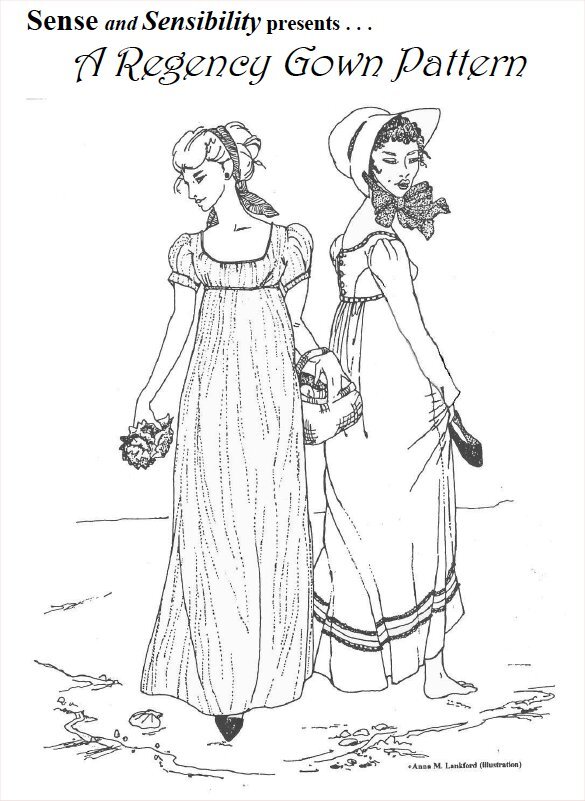
Sense & Sensibility Regency Dress

Envelope cover illustration - 2 views


This is the original source of one of the Simplicity patterns, which was licensed from the creator of this one. In my opinion, this is better than the mass market variant because it is more accurate. For my purposes, it is possibly slightly earlier in style that my aim (1801-1812), but a) the author then says "1810s", which would still encompass 1818, and b) US fashions were ever so slightly lagging compared to Europe due to the time for new ideas to travel.

So, the envelope designs didn't seem to be quite what I needed, but then I looked at the photographs of made-up versions, and the first image has almost exactly the neckline and sleeves of the Ginsburg dress. 

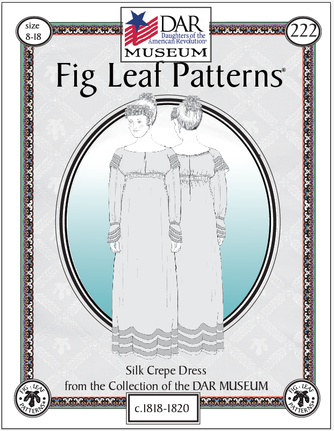
Fig Leaf 222

Envelope image for Fig Leaf 222, showing a sketch of the DAR Museum dress

This pattern is specifically based on the DAR Museum dress, but I found it after I had bought another pattern. I would definitely like to buy and try this one later, should I find the need to make another Regency era dress!

~~

So what to do? 

Sizing
The Laughing Moon pattern cover sizes up to 56"/48"/58", whereas the S&S one only goes up to 48"/41"/50" AND requires a supplement to make the larger sizes.
Fig Leaf 222 goes up to 51"/42"/56".
Format
Laughing Moon is paper only for this pattern.
S&S has both paper and PDF options available.
Fig Leaf seems to be paper only
Cost
Laughing Moon is $18.00 plus postage or £23.99 (no postage) from Etsy
S&S in PDF is $9.95 for the base pattern, plus $2.95 for the large chest supplement, no postage, but printing out costs of course.
Fig Leaf is $23.00 plus postage.

In the end I bought the Laughing Moon pattern via Vena Cava on Etsy. Why? The bodice was closer to the later style ones I am hoping to recreate, even though the sleeves aren't quite right. I also figured that if I can't get the sleeves right, I can buy the PDF of the S&S one still, and Frankenstein them together...

Colours

The official descriptions of both dresses describe them as being Clarence Blue. But what is that, and where does its name come from?

With regards to the Queen herself, there are possible indications of the colour she liked. I wrote a separate post last week on Queen Adelaide and blue as this section was getting Rather Long!

Neither my Inspiration dresses nor the portraits of Queen Adelaide are categorical confirmation of precisely what was "Clarence blue". I feel that I have two possible directions I can take.

  1. Follow the colour that is on the garment(s) now
  2. Attempt to decide and re-create the garment in the shade I feel is closest to Clarence blue.

As I am intending to re-create an extant dress, I will be going in direction 1. The colour of the extant garments were what drew me to them initially, so in keeping with that, I plan to make my dress in a colouration similar to the shade they are now, 200 years after they were made. This may not be the original colour, nor may it be a true example of Clarence Blue, but I loved it from the start and that is what I will use. 

Modern fabrics in Petrol Blue, Teals, and dark Turquoises seem to be the best representations of the colour I initially saw.

Fabrics

Both original dresses were in silk, suggesting evening wear. I am not planning to wear either in that way, so I am considering either a heavy cotton or a light wool (or wool mix).


Links/images to dream fabrics
Links/images to more realistic fabrics

Wednesday, 9 September 2020

Clarence Blue & Queen Adelaide

This post includes sections originally from an upcoming post on plans to recreate the Ginsburg &/or DAR Museum dresses, both of which are described as being made of "Clarence blue" fabric.

I fell in love with the two dresses illustrated above due in a large part to their beautiful colour, which is described in their official entries as "probably" Clarence blue. Not knowing anything about this colour, I set off to figure out a) what it was, and b) whether I could buy fabric this colour from modern vendors.

According to both the Cora Ginsburg catalogue and the write-up at the DAR Museum, Clarence Blue was a fashionable colour from c1818. It was called Clarence blue because it was apparently the favourite colour of the new Duchess of Clarence, Adelaide of Saxe-Meiningen (1792-1849). Adelaide had married the aging Prince William, Duke of Clarence in 1818, and both collections suggest that this marriage was the trigger for her favoured colour becoming fashionable. While this sequence of events is entirely logical, I wanted to verify this information before I spouted it off to anyone else. 

Evidence for Adelaide's personal preference in colours is somewhat scanty, or just poorly recorded because no one else has been interested in discussing a former Queen's favourite colour. While I found a number of portraits of Adelaide in shades of blue, neither the National Portrait Gallery nor the Royal Collection Trust (who own many) made mention of any significance of the colour blue to the lady herself. 

This lovely essay by Alden O'Brien of the DAR Museum talks about the fashions in 1818 introduced by or named after the Royal marriages of the Dukes of Clarence and Kent. His essay is a wonderful resource for me, not only for the work he's done on discussing the shade(s) of blue attributed to Adelaide, but also by sharing some fantastic close-ups of both my Inspiration dresses, which I've not seen elsewhere. He also shared the final destination of the Ginsburg dress, which he states is now held by the Met Museum.

Excellent!

O'Brien notes a great reference to "Clarence blue satin" from September 1818, and also states that William DeGregorio (who wrote the Ginsburg catalogue section) has found earlier references back to the February of 1817. I found another reference to "An Adelaide blue silk dress" in the June 1831 issue of The Magazine of the Beau Monde, although the journal unfortunately does not come with any illustrations, nor any further indication of the precise shade of blue. As so often happens, the assumption that the reader already knew what the author was talking about leads to a sad and unintended loss of knowledge. These entries definitely indicate a contemporary association between the broad colour "blue" and the person of Adelaide of Saxe-Meiningen.

Shade?

But what shade of blue was Clarence Blue?

My first assumption would be to look at the two dresses and to assume that they exemplify the colour, but DeGregorio and O'Brien both make it clear that this is an assumption made through correlation, not a definitive proof of the shade. What do I mean by that? Here are the following things we know for sure:

  • There was a shade of blue popular in c1818 which was referred to as Clarence Blue
  • These dresses date from approximately 1818 based on other evidence (e.g. skirt style, provenance etc.)
  • These dresses are in a shade of blue

What we don't know for certain from these dresses specifically is that these dresses are proven to be in the shade that was called Clarence Blue.

Sarah Walden wrote a blog post in 2011, where she tried to show swatches of all the colours popular during the Regency era. This is a really interesting post, and I find it really useful for seeing the broad categories of where a named shade fit, but I'm not sure whether all are accurate. Her list does include Clarence blue, but the colour is very different to that of the dresses. Sarah describes Clarence blue as being "another ... sky blue", and her swatch is very similar to the colour shown on the ColourLovers website as "Clarence blue" (hex: 79A3DD; RGB 121, 163, 221).

I feel that Walden's swatch for "Prussian blue" is a better match with the colour of dresses, or another ColourLovers swatch named "Clarence" (hex: 3A5470; RGB: 58, 84, 112). There appear to be a multitude of colours described as Clarence or Clarence blue, which vary incredibly. Add in the variations of fading over the 200+ years between 1818 and now, and I can understand why we are viewing such a wide variety of possible answers.

DeGregorio refers to her 1831 NPG portrait (see below) as an example of her wearing "the distinctive hue", and also describes it as a "deep sapphire colour". 

O'Brien refers to another 'new' colour that became fashionable after the accession to the throne of Adelaide's husband, now King William. This colour was called "bleu Adélaide" and was a light blue rather than the richer sapphire identified by DeGregorio. This suggests to me that sometime in the intervening centuries the two shades have become merged into the same name of "Clarence blue". 

Possible Examples

There are numerous portraits of Adelaide surviving, where she is wearing shades of blue, although I am not able to tell whether these are likely to all be attempting to depict the same original shade. Below are a few that I can share which are a) reproduced online in colour, and b) reliably identified as being of Adelaide as either the Duchess of Clarence (1818-1830) or Queen Adelaide (1830-1849).

RCIN 420216. Royal Collection Trust. c.1818?

Duchess of Clarence by Mrs James Green c 1818
Portrait of Queen Adelaide, when Duchess of Clarence, c.1818
(c) RCT

This dress in this image is a light and bright blue, without any obvious green or red undertones, except to the rear of her right shoulder (left as you look at her). 

NPG 1533. National Portrait Gallery, London. c.1831

Queen Adelaide by Sir William Beechey c 1831
Queen Adelaide (Princess Adelaide of Saxe-Meiningen) by Sir William Beechey, circa 1831.
CC BYNCND

The image here is quite dark, but does show a beautiful blue velvet with a slight hint of green to it. It is definitely not a "sky blue" shade.

RCIN 420239. Royal Collection Trust. 1844

Dowager Queen Adelaide 1844
Miniature of Queen Adelaide, 1844
(c) RCT

This is a miniature image of the Queen Adelaide, which is dated 1844 on the reverse. The dowager Queen is again wearing a vivid shade of deep blue.

RCIN 405389. Royal Collection Trust. 1849

Queen Adelaide portrait 1849 by Winterhalter
Queen Adelaide, 1849, by Winterhalter
(c) RCT

This portrait of the Queen was one she sat for shortly before her death in the same year. The RCT describes her as "wearing a black lace cap", but the trim on her lace cap appears quite blue in the website image. This blue looks to me to be a more green based one, compared to all the earlier portraits.


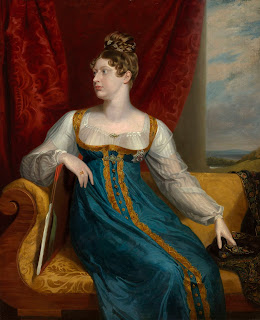
The exact shades of items in portraits cannot always be assumed to be completely accurate. Princess Charlotte wore a blue sarafan-style dress (known as "Princess Charlotte's Russian Dress") shortly before her death in November 1817. The Royal Collection Trust holds both the original dress and a portrait of her wearing it, and a second variant of the portrait is in the National Portrait Gallery. None of which have precisely the same shade of blue. 

Conclusion

The dresses as they are now, show a green base to the blue, which isn't really reflected in the portraits. The fashion plates shown by O'Brien also show a deeper blue akin to the shade in the portraits. My current opinion, based on the information I have to date, is that the deep rich blue of the portraits is the shade originally referred to as Clarence blue; and that the lighter sky-blue shade was the shade described in 1830 as "Bleu Adélaide".

Saturday, 5 September 2020

The Visible Layers: Part 1 - Questions, &, Inspiration for the Dress

My big initial questions


Day vs Evening dresses. Walking dresses. Practicalities based on Promenade dress vs dancing dress.

So, continuing on from my general musing on what "I" would have been most likely to wear, I also started to consider practicalities. These practicalities are twofold: 

  1. Where will I be, what will I be doing, and what time of year?
  2. What is my realistic budget (financial & chronological)?
The answers to this are:

Question 1:
  • Bath, so England, and more to the point, outside in the Promenade
  • Walking and "showing off"
  • Late summer into Autumn
Question 2:
  • Financially
    • If I spread financial costs, then I can afford a nice-but-not-elite dress. So good quality fabric, but probably not 100% natural fibres unless there's a nice sale on with what I need.
    • I might be able to make a cheap polycotton test run dress, but otherwise I will only be able to afford the fabric for the main dress. Fabric, followed by notions, will probably take the largest portion of my budget.
    • New era: Also, this is one event, so it's not reasonable to invest that much into a new era which I may not regularly return to.
  • Chronologically
    • I am a slow sewer, and as I currently do not own a sewing machine - the one I use is locked down at the opposite end of the country from me right now - I will be hand-sewing everything to begin with, so I feel that it would be more realistic to make one versatile dress, rather than separate day, walking or evening dresses. 
    • I will need to make/obtain a shift, stays, and a petticoat (or two) at a minimum, and will have to make the appropriate financial or chronological adjustments to own them. This affects the dress in that time spent on those layers takes away from time available to make another dress.
    • Time also means that a very decorated or fancy dress would be less practical. One with clean lines, and relatively simple decoration will be easier to complete well within the time constraints.

Decision:

A walking dress would be ideal, but a day dress would be more versatile and could even potentially be an evening dress with appropriate accessories. 

Inspiration

These two dresses are the two I feel completely in love with. Initially the colour caught my attention, but each has elements which I really like, and which also fit with the "me" I want to portray.

Three regency dresses with shawls. Right two images are of the same dress.


The dress on the left is listed in the 2016 Cora Ginsburg catalogue (PDF). It is described as being from the USA and of "Clarence-blue silk twill" or of "levantine", and is dated to c1818. The deep blue shawl Kashmiri shawl isn't original to the outfit, but would be appropriate to the period. I adore the details at the cuffs, the shoulders, and across the chest, but I suspect that my skills aren't quite there yet.

Wrist details for Ginsberg dressHem details for Ginsberg dressChest and shoulder details for Ginsberg dress


The second dress is in the DAR Museum, and is dated to c1818-1820. This dress is also described as being in "Clarence-blue" silk, and I freely admit to having fallen in love with the colour of both these dresses. The dress does not appear to be made of a "shiny" silk, but rather a crepe.

The decoration on this dress is in the form of bands of shiny bias-cut satin silk that has been sewn on around the shoulder caps, on the cuffs, and at the hem; three bands in each location. There is also another band of the same contrasting fabric around the high waist. The triple bands sewn at the edges of the shoulder caps and those at the cuffs are all of narrow equal widths; probably a few cms at most. In contrast the bands at the hem are graduated in width towards the hem, and are significantly wider.

The sleeves appear to have an extra frill at the edges of what looks like lace. The neckline is simple and the Museum has chosen to fill it in with a file almost transparent ruffed chemisette, and it is not clear whether this is also at the cuffs, or if that is a separate piece of decoration.

Wrist details - DAR museum dressHem details - DAR museum dressBodice & shoulder details - DAR museum dress


It is interesting that both these dresses are believed to have been made and worn in the USA, but are in a colour that because famous and fashionable specifically due to Princess Adelaide, who married the British Duke of Clarence in 1818 (hence the name). It is believed to have been her favourite colour.

Unfortunately I've not been able to find any fabrics being sold specifically as "Clarence blue", but I have found some modern shades which seem to approach this blue-with-a-greenish-hint. More on that in a later practicalities post.

Other dresses I liked 

...but ultimately haven't gone with (this time?)

1. Princess Charlotte's Russian Dress 

(That's it's actual name!)

I saw this one in an exhibition at the Queen's Gallery a little while back, and I still love it. It's definitely on my list of dresses I'd like to recreate one day.
Painting of Princess Charlotte in her so-called "Russian Dress"

2. Tat'yana Borisovna Potemkina, by Vigée-Lebrun, 1820

I love the colour and the cross-over style front. The long sleeves with the lace are also quietly beautiful.

Painting of Tat'yana Borisovna Potemkina


3. Jane Johnstone's Mourning Dress

This dress in the V&A is marginally later than I was originally looking at, but I love the simplicity and shape of the bodice decoration. I'm also a big fan of both black and of velvet, although I've not sewed it in decades. My other half likes the decoration on the bottom, as well, so we both like different elements of it. I think this one is on one side for if I ever need a regency or even early Victorian evening/ball dress.

1820s black velvet mourning dress in the V&A
 © Victoria and Albert Museum, London


Formal mourning dress of black velvet and grey silk satin decorated with satin piping and appliqué. The dress is full length and has a wide, shallow neckline outlined with grey satin piping. It is lined with cream silk in the bodice and black silk grosgrain in the skirt. The short puff sleeves are decorated with an appliquéd satin motif stemming from the shoulder seams and are finished with the same satin piping. The waist is high but falls a good 5-10cm under the bust. Decorative lines of satin appliqué stem from the waistline to the neck and shoulder seams on the front of the dress and two lines of piping form a V shape from the waist to the shoulder seams on the back of the dress. The dress fastens at the back from the waist to the neck with seven hooks and eyes and a drawstring at the neck. The skirt is gored with a circumference of 220cm around the hem and is gathered slightly at the waist. The hem of the skirt is appliquéd with a wide band of an overlapping, simplified floral motif in grey silk satin, underlined with a band of satin piping.


Wednesday, 19 August 2020

The Base Layer

This post is about my plans for making/buying Regency era underthings for my 2021 Regency Project.


The Layers

There are three main undergarment layers in the Regency period. I own nothing suitable at present, so I will need to buy/make everything here.

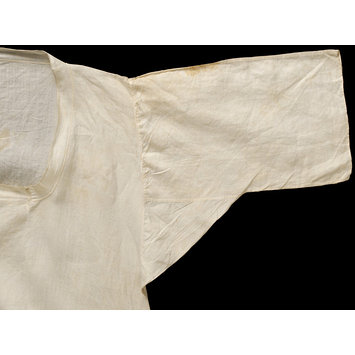
1. A shift - This will be a basic, square necked garment. The purpose of this garment is to protect my outer garments from me, as in my sweat etc. The shift is easier to change and to wash, so was very important for keeping outer garments less smelly or dirty. They didn't wick everything away, but less sweat on your fine dress is still better. In the Regency era there seems to have been some variation on whether your shift had sleeves depending on what you were wearing. When worn with a long sleeve dress, it could have had short sleeves like the V&A example below, but with the very short sleeves, it may have just had a slim shoulder strap. Unlike a medieval shift (the ones I have currently!), a Regency shift has a much more open and square neckline to fit under the dress necklines of the era. Although women were still rarely showing actual cleavage at this point, the area between the neck and breastbone was more likely to be partially or completely uncovered in comparison with earlier eras. That necessitated the change in necklines.

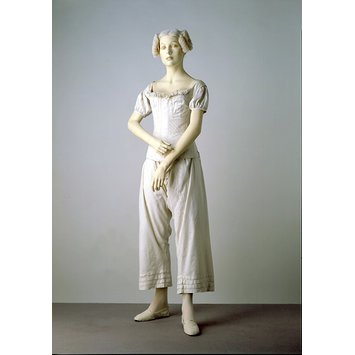
1a. Long drawers or pantalettes. In the later Regency era, this layer sometimes also included leg coverings (see the below the stays in the next image). These could even be visible below the skirts for some women. These were two single legs gathered to a band as clothing approaching modern knickers wasn't worn by "nice" women at this point.

2. Long stays (image from the same page as the V&A shift above). Along with the change in necklines and shift patterns, this era also saw a change in undergarments. Others have done far more research than I on the changes of support garment during this era, but in summary, the main changes were a distinct "cup" area which caused/was caused by a change in how the breast tissue was shaped and supported. Prior to the introduction of the Regency silhouette, women's breast area was supported by being bound against the body, usually either with a specific boned undergarment or via the cut of their underdress or kirtle. The flimsiness of early Regency dresses seems to have triggered a need for a new type of support, which went through various iterations. In the c1818 period I am looking at, this would have been long stays. Long stays could be boned or corded, and gently contoured the body from armpit to around the hips, and seem to have included dome kind of breast cupping or pocket.

Regarding the stays I will make or buy, I read this rather interesting study, which seems to suggest that by the time I'm looking at, cording was beginning to be dominant over boning as the method of support. Depending on patterns and cost of materials, I will seriously consider whether "Harriet" would have worn an older set of stays that from 10+ years earlier, or whether she might have updated to the newest style... 


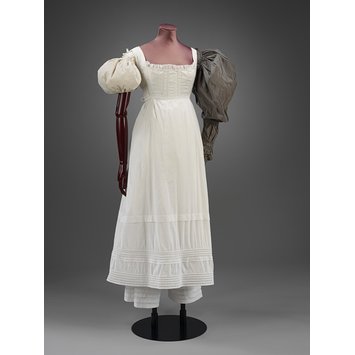
3. A petticoat which goes over the stays and protects the dress while creating an appropriate shape. Like the shift, the petticoat had been forced to change shape from earlier eras. Some Regency petticoats were hung on thin straps from a high underbust waistband, and others were entirely without straps. I am practically minded, so thin straps seem logical to reduce the risk of it slipping!

The image below also includes artificial arm puffs to boost the shape and stability of early Regency sleeves. That's not in my plan so I won't need them at least!


I'll skip (making) other underwear and wear normal tights instead of stockings.

To do list for an underwear layer:
  • Buy a basic suitable shift from a vendor, possibly at the next TORM that runs
  • Make a set of long stays. Long ones because I'm "squishy", and need more control to achieve that silhouette.
    • Buy a kit and pattern - 
      • I'm looking at getting this RedThreaded kit if the postage isn't too punitive and I choose the boned variant
      • If I go for corded, then maybe the Laughing Moon pattern #115 . This pattern also includes instructions for a simple chemise. I found an online class that follows the LM pattern as well. These instructions may help if I go it alone. 
  • Buy fabric.
    This layer will be next to my skin, so it needs to be breathable. Going by museum pieces and the Foundations Revealed article (linked above), I will probably buy cotton instead of linen, as cotton seems to be beginning to dominate for underwear by the later Regency period.

    A middle class lady may well have had contacts with the owners of the burgeoning local cotton mills by blood, marriage, or friendship, so wearing cotton would have been a practical choice.

Next post, next layer! The Dress.

Sunday, 16 August 2020

A Regency Outfit?

So, my first sewing project for 2020 is looking like it might be a complete Regency outfit...

It's not an era I have a particular interest in, as far as costume is concerned, but it is an era I love for fiction settings. The Discord group I am a part of has suggested going to Bath and either joining with, or meeting up with those who are formally part of the 2021 Jane Austen meet-up. So, that needs Regency appropriate attire.

Now my first thoughts for the Regency era are based on ball dresses and outfits worn during the Season - both from museum collections and in novels. They don't appeal at all. I'm neither young nor sylph-like, and I feel that I'd just feel so self-conscious in a flimsy muslin dress, let alone a White dress. My disabilities affect co-ordination, so white as a colour is deeply Out for me - I will be wearing something on it by the time I get there, if not before I leave the house. 

So, no flimsy, white muslin for me. Does that mean no Regency clothes at all?

I'm older, married, and also not rich. If I was living then, I would have no need to wear the "pretty" clothes of a debutante or other husband-hunting Society lady. What if I dress as a middle class lady, and one of middle age? Oh, and it's winter, would an older lady really have worn muslins in November? What about white? Wasn't that for young virginal women who were showing off their purity for potential husbands? I don't need that, I can "wear colours", so I shall. I don't have a lot of money, so I can see it would be reasonable to wear something less fussy than a young, and/or wealthy woman.

On "It's winter!", what about a coat, or headwear?

Oh, and underwear. Oh hell, I'll need underwear - you can't get an authentic outline without the right underwear!

So, as it's very much early days, and nothing is decided, but below are the beginnings of my thoughts, inspiration, and tentative plans.

I've fallen in love with two dresses from c1818, so I'm looking at narrowing my clothing to broadly that year. 

I've realised that my way of approaching the concept of a dress from a specific period is to create myself a rough character. That "character" is mostly a meditation on who would I have been if today was 1818? 

My "character"


As an "older woman", I can get away with have clothing items that are a few years out of date as don't feel I'd have been in the first stare of fashion). I'm giving 'her' the name/reference of Harriet or Henrietta.

So who is this person I feel I would be?

Middle class - I have never been wealthy, but having grown up solidly middle class, I feel that that is a background I feel confident in portraying. It's also more realistically achievable for me - while I couldn't afford fine silks even now, I can afford to buy decent quality fabrics if I budget sensibly.
Older - I have no desire to pretend to be younger than I am, and I am not ashamed of my real age, so I'm content to portray a woman in her 40s
Married - hopefully my other half will be coming to Bath with me, and may even be willing to dress up too. A married woman would be more likely to wear the darker and richer colours I prefer, and wouldn't be looking for a marital partner. A single woman in her 40s would have been reliant on her relatives in a way that a married woman was not, and I feel that I am pragmatic enough to have married for "job security" when I was younger. 
Comfortable - By this I am referring to her preferences in fashion. She's neither first stare of fashion nor totally out of date. She's comfortably within the range of normal for her era, without being at all obvious.
Quiet - not physically quite, but in line with the "comfortable" above, she is not overly visible or noticeable. As someone who is not always seeking the most up-to-date fashions, she's therefore less obvious and more likely to blend in with the background scenery. This fits with an older middle class lady who is not seeking to raise her station or marry off children. She has no need to be noticed, so she dresses "quietly" so as not to draw excessive amounts of attention. I'm an introvert, so I am more comfortable and confident when I am not the centre of attention, and Regency Me is going to be the same...
Neither poor nor wealthy - this is different to class, which was somewhat less easily changeable. Because my creations have to live within my real life budget, I choose not to portray someone who is vastly more wealthy than I am. I choose to portray a woman who is comfortably off, but not rolling in money. She can afford nice fabric, but she won't have multiple changes of clothing nor a vast wardrobe of clothes to pick from. She prefers to buy/make one to two good quality items and vary how they look with accessories. Her clothes will be well made and made for/fitted to her, rather than second-hand and made over ones. They aren't high fashion, because that lasts longer and she's not so wealthy as to waste money on buying new clothes before the older ones are unsuitable for wear. She has some servants, but her clothes are cut to allow her to dress herself where possible rather than being reliant on employing a dedicated ladies maid.

Creating the Costume


Subsequent posts on this topic will go through my plans for making/buying the different layers to dress u[ as this character. Before I go though, here is a great guide to the general outline of the layers: http://www.uvm.edu/~hag/regency/tips/