Showing posts with label Clothes: Hats. Show all posts

Thursday, 8 October 2020

The Outer Layer - Head

Oops, procrastination and squirrel brain posts have unintentionally pushed this one back from when I originally scheduled it to post... By 2 weeks at least now. Sorry! I had intended to do the Regency Wardrobe group as a straight series of posts, but brain go "Wheee! Look over there!" and I did. Mea culpa...

So back to the original plan: The outer layers of my planned Regency costume.

 The outer layer in this project is the layer where I will attempt to make something, but where I accept that I may well run out of time. For the purposes of these posts I am going to list the things I would like to make (and may make later if I don't have time this time), and alternatives I may consider adding instead. I am considering here three specific areas:

  1. Head
  2. Body
  3. Feet

Head

Head coverings of some kind were both normal and socially acceptable for adults of both genders. For women what was expected would vary depending on their age, but even in a ball situation, the hair would have some sort of decorative covering, even if it did more to adorn than conceal. Depending on your age, wealth, and taste, these could range from simple and plain, to incredibly elaborate affairs. Common types of coverings included Caps, Bonnets, and Turbans.While millinery was a definite profession by this time, it wasn't uncommon for women to buy hats to trim at home, or to trim and retrim the same hat to go with multiple outfits, so fashion plates were useful places for the contemporary woman to gather inspiration. It has been argued that these plates show the extremes of fashion, akin to modern catwalks, or show composites of various options which could be mixed, matched, and omitted according to the wearer's tastes. Being able to modify or create your own headwear allowed women, in particular, a lot of capacity for personalisation.

So what would a women in around 1818 have worn throughout the day?

In the morning, women wore lighter headwear, such as lace caps, linen bonnets, and similar items. These were "at home" items, and seem to have been commonly made of the same sort of fabrics and colours as both visible and intimate underwear. The fashion plate below shows a woman sitting in a very decorated yet simple white dress. The tucks and lace on the hem are reminiscent of petticoat edgings. The dress has looser sleeves than the dresses worn outside or later in the day, and the fichu at the neckline would have kept her warm in a colder house. Her cap is completely in line with this "undress" fashion style, with a deceptively simple fabric cap to keep her hair out the way. I say deceptively, because like her dress, the simple shape is then covered with a huge ribbon (the width and depth of her forehead), and a very frilly decorative border. The whole ensemble is about the impression of intimacy, for an at home, without actually being either simple or undressed.

Morning Dress, 1818, La Belle Assemblée


Candice Hern's Regency World shows a number of fashion plates of hats dating from this about 1800-1817. Although there were variations each season and by activity, from about 1815 one popular shape for daywear was of a blocky crown (think of the crown part of a top hat) tilted back about 45° from the face, with a curved brim. The brims on this style gradually grow deeper and more exaggerated as the years progress. By 1818 a fashion plate from La Belle Assemblée shows a deep sweeping curved brim coming out from the nape of the neck outwards to shade the whole face, and then upwards above the face. The upper tip of the brim is about the same distance up from the head as the crown, or even a little further, and forms an angle of about 90° with the crown. Depending on the style, some brims form a straight line out from the crown, and others have a slight curve. All the plates I've seen of this style of bonnet, show that the edge of the brim, and the top of the crown were Very heavily decorated, with options such as lace, ribbon ruffles, and what looks like cording being quite popular. They were then finished with a broad ribbon running from the centre of the crown down to a point below the chin. This was to secure the bonnet to the head. It's not clear from the plates whether this ribbon was sewn into the seams of the bonnet form itself, sewn into the covering, or attached underneath a band around the base of the crown. Some prints (e.g. the middle left one in the image below) have a triangular effect with the chin ribbon being mirrored upwards and then along the back edge. The others on the page show a slightly puckered ribbon extending out below the crown ribbon.

Parisian Bonnets, 1818, La Belle Assemblée

Evening Dress fashion plats often seem to show a type of hat that is reminiscent of military hats, covered with a riot of feathers. Unlike the bonnets described above, these are worn much more vertically up from the head, extending the profile upwards, with the feathers above even the tops of the hats. Other evening dress plates show more turban like affairs wrapping around the hair, and again topped with feathers.

An undressed bonnet was not a thing that a lady of the time would have accepted! In addition to the edge trims, bonnets were also decorated with floral decorations, and possibly other natural items. This poke bonnet from the 1820s at the Met Museum, while of a different bonnet shape from the 18-teens, shows a wonderful riot of leaves, flowers and other plant matter. Decorations were seasonal and also influenced by activity. Feathers seem to have been prefered for evenings, and also for winter outdoors activities like riding. Flowers were popular for daytime wear in the spring and summer. Autumn seems to have brought in berries, leaves and other foliage. Ribbons

Hats and bonnet forms were often covered in silks, which could be of a coordinating or in a contrasting colour. Other fabrics could be used depending on your means and your outfit, but silk appears to have been both the most common (or the most common to survive) and the ideal described in the women's journals. 

Making

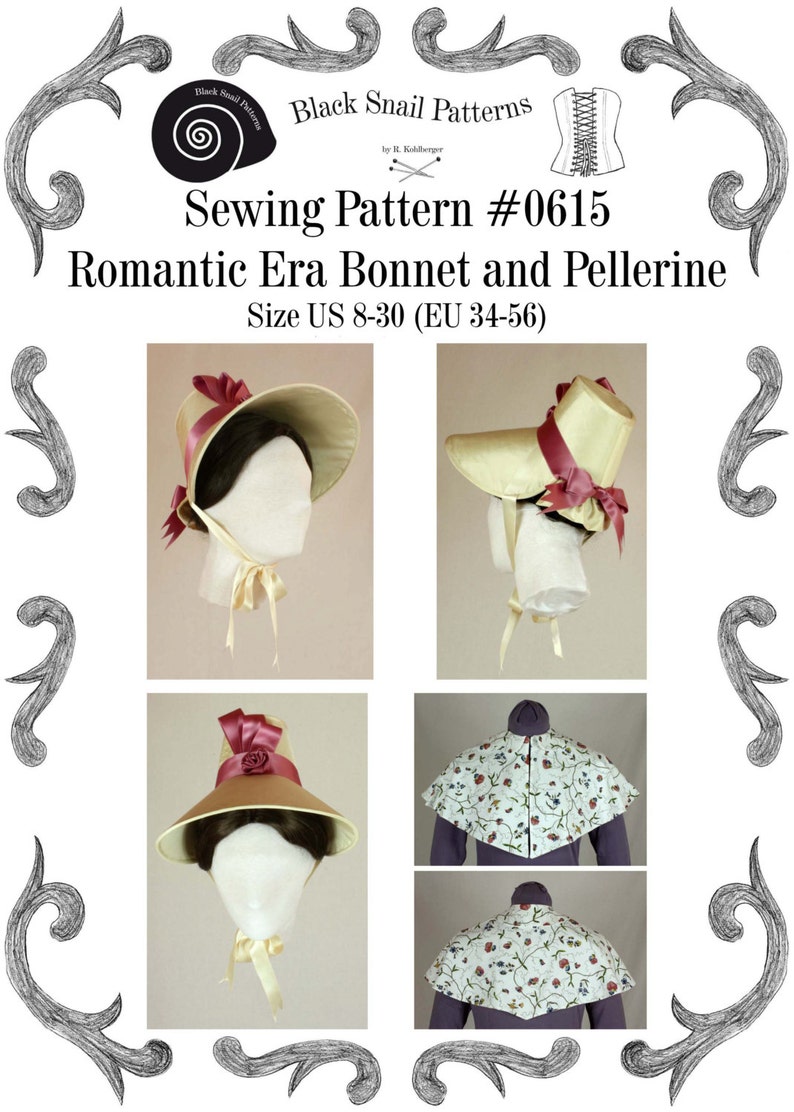
So what have I gone for? I decided quite quickly that a bonnet in the style of the Parisian Bonnets plate above would be the most appropriate option for me, based on the time of day (afternoon), the activity (a promenade), and my personal preferences. While looking at Black Snail Patterns during their sale, their "Romantic Era" bonnet pattern fell into my basket. *cough* Although this pattern is designed for about a decade later, the broad shape of the bonnet in the pattern is not dissimilar to the one above, and I felt that it wouldn't be too difficult to adapt to the 1818 shape. If it doesn't work, I may just go ahead and draft my own pattern instead!

Black Snail Sewing Pattern #0615 - Romantic Era Bonnet & Pellerine

I am currently piecing together the PDF pattern for this bonnet, as I plan to decorate it for part of my Harvest Hat challenge entry.

I will post the Body & Feet work in a separate post, probably tomorrow, as this one has got rather long. Again.

Saturday, 26 September 2020

Harvest Millinery - inspiration post

This is going to be a fairly light post with links and images to inspiration sources I have for each of my final ideas. This is not a decision post, because I haven't decided yet!

1. Pseudo-medieval hood(ie)


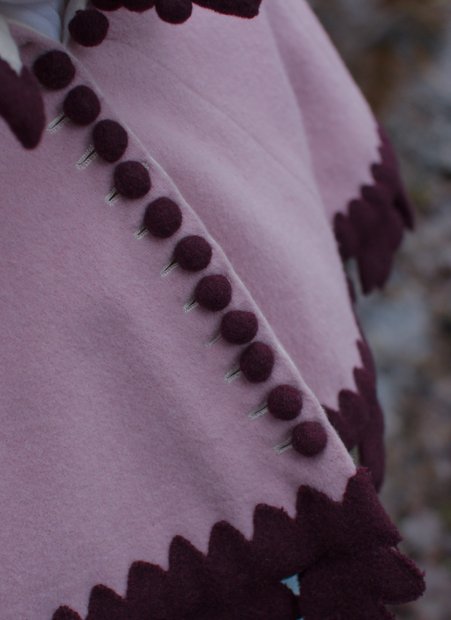
This image from Rosalie Gilbert has a shape I love. I prefer closed to open hoods, but the buttons would allow me to make a hood in the open style but which can be closed when I want or need more insulation from the elements. She also includes a useful way to draft an appropriate pattern for this style.


Couture Mayah's post from 2011 shows a rather beautiful hood where she trims the hood using a contrasting wool for the dagging at the edges. 


Racaire's Workshop has images of a lovely embroidered hood made in c2009. While the quality of the embroidery I feel is far beyond my current abilities, I am inspired by the use of contrasting the thread and fabric colours. Racaire suggests using chain stitch, which I know and could possibly work with providing the imagery was Very simple.

Notably both the previous two examples refer to the Medieval Tailor's Assistant book, which I already own.


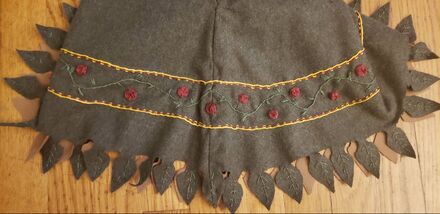
Finally, I was really inspired by the decorations on the second (green) hood shown by Maille is Riveting. The idea of a simple band of decoration, plus the leaf-shaped dagging really got me excited to have a go. 

I think that even if I don't do this for the Challenge, I want to do one anyway before the end of the year! In that situation, I will probably make the shape somewhat different from a normal late medieval hood, and take inspiration from ponchos (a longer back), consider making the front more of a scarf cross-over effect, and dropping the liripipe altogether.

2. Simple Regency bonnet

This is the bonnet pattern that happened to fall into my basket during the recent Black Snail sale:

Black Snail: Romantic Era Bonnet pattern

I could potentially trim the shape with autumnal themed items, like berries and leaves. I'm not sure, however, how autumnal colours will go with the petrol-blue of the dress I want to make.

This hat from the Museum of Fine Arts, Boston, is a nice inspiration for trimming an 1820s hat. Although with the MFA hat being of a different shape to my pattern, I can't be certain how accurate it would be to transfer that style of decoration across to another type of bonnet.


Another 1820s hat, but from the Met Museum, which has a brim somewhat closer to that of the pattern above. This one is even decorated in a style that could be described as almost Autumnal!

For a style closer to the pattern, these images from a fashion plate of 1818 (La Belle Assemblée) show floral, foliage and ribbon decorations. Source: Flickr.

3. Trimmed late Victorian hat

Flipping through the Met Museum's web archive, I can see that straw based hats with wider brims were in fashion (with variations of course) from the 1890s through to the 1910s. That covers the 1890s of the fan skirt alongside the "Edwardian" of the blouse. While this costume would not be historically accurate together, I feel that none of it would be too out of place aesthetically when worn together.

Possible sources of inspiration (All (c) The Metropolitan Museum of Art)


This hat is dated 1892-95 and is made of straw with silk and feathers. The floral top decorations could make a nice historically inspired hat, but this hat itself would be useless in a practical sense because it is angled so as to leave the entire back of the head and neck exposed. No good if I wanted to wear this to keep the sun off.

The Met also have a lovely simple boater from c1890, but I would be unsure whether that would be a woman's hat. That said, in a non-accurate costume, does that matter?

Moving forwards to the 1910s, I found some much more useful images for inspiration. By this decade the hats seem to be angled towards the back of the head again, making them more useful for my modern wear. They are exceedingly extravagantly decorated in some cases, but that might be good for the Challenge, and at the same time, I can deviate if I choose since I'm not intending on creating a true replica.

This 1910s straw hat has a band of what might be velvet underneath the brim, and a large cluster of flowers across the front brim. This style could be an awesome source for a Challenge hat - Straw base, autumnal coloured velvet band, and then a riot of autumnal leaves and flowers with a large ribbon around the crown.

Another straw hat dated c1911 shows how the brim width and crown depth could vary. That's quite useful when finding a relatively inexpensive base straw hat to begin with.

Instead of straw, this c1910 hat is described as being made of cotton, although in a similar shape and weave to the straw ones above. Like the first 1910s straw hat, this one has a band of fabric below the brim, and a wide band around the crown (of the same colour in this instance).

A last straw hat, dated again to c1910, is also made of straw. It's quite a bright yellow, compared to the first two so may possibly be dyed, or even painted? In common with the first and third of 1910s hats linked above this hat has a band below the brim, and another around the crown. As for the first straw hat, the hat is decorated with flowers and leaves although here they are attached onto the front of the crown itself. This hat is also different in that it isn't the simple circular or oval shape, but instead has a downward sweep almost presaging the 1920s cloche hat. It's a rather lovely hat to take as a modern sunhat due to the deep drop of the brim towards the back, which would nicely protect the nape of the neck.

Unfortunately, due to rights restrictions, none of images of the 20th Century hats can be reproduced, so you'll need to look at them on the Met's website.